


7 Things You MUST Know Before Buying HomeFi Internet
- Apr 15
- 4 min read
If you’re tired of slow connections, limited options, or overpriced providers, chances are you’ve come across HomeFi as a potential solution. It’s especially popular in rural and underserved areas across the U.S., where traditional broadband struggles to reach.
Before you decide to buy, many users also look for ways to save, and that’s where a homefi discount code can help reduce your upfront or monthly cost—but pricing is just one piece of the puzzle. You still need to understand what you’re getting, how it performs, and whether it actually fits your needs.
Let’s break it down in a practical, no-nonsense way.
1. What Is HomeFi Internet?
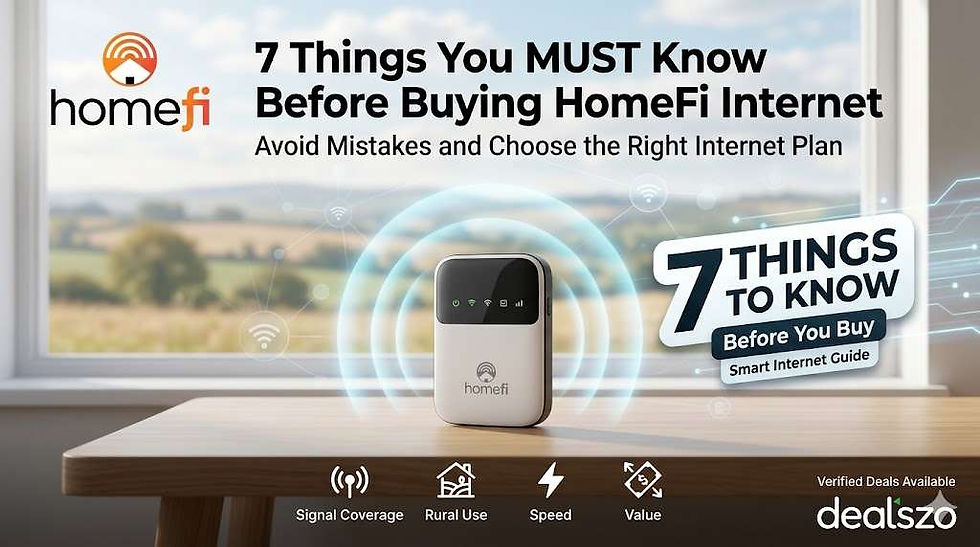
What is HomeFi internet? At its core, it’s a wireless internet service that runs on cellular networks instead of traditional cable or fiber lines.
Instead of connecting your home through physical infrastructure, HomeFi uses nearby cell towers to deliver internet through a dedicated router. That means:
No digging or wiring required
Faster activation and setup
Availability in places where cable and fiber don’t reach
This is exactly why it’s becoming one of the most talked-about rural internet solutions in the U.S., especially for users who feel stuck with slow DSL or no options at all.
2. How Does HomeFi Internet Work?
If you’re asking how does HomeFi internet work, here’s the simple version: the router connects to multiple carrier networks and automatically switches to the strongest signal.
This gives you a few key advantages:
Better reliability compared to single-network hotspots
Access to 4G LTE and, in some areas, 5G speeds
Easy plug-and-play setup without a technician visit
What this really means is you can get online within minutes of receiving the device. For many users, that convenience alone is a huge upgrade over traditional providers.
3. Don’t Assume It’s Truly Unlimited
This is where most people get caught off guard.
While some plans are marketed as unlimited, the reality often depends on HomeFi internet plans pricing and the fine print behind it.
You should always check:
Whether there are soft data caps
If speeds are reduced after a certain usage
Any fair usage or network management policies
For casual browsing, you may never notice a difference. But if you stream, game, or work from home, these limits can impact your experience significantly.
4. Your Location Directly Affects Performance
Unlike fiber or cable, wireless internet is heavily dependent on signal strength.
That means your speed and reliability will vary based on:
Distance from cell towers
Network congestion in your area
Physical obstructions like trees or buildings
Even though it’s promoted as a strong no contract wireless internet option, it’s not identical everywhere. Two users in different locations can have completely different experiences.
A smart move is to test signal strength in your area or check coverage before committing.
5. No Contracts = Freedom (With a Tradeoff)
One of HomeFi’s biggest advantages is flexibility.
You get:
No long-term commitments
No cancellation penalties
The ability to change or stop service anytime
This makes it ideal for renters, travelers, and people who don’t want to be locked into yearly agreements.
However, here’s the tradeoff: monthly costs are often higher compared to traditional providers that bundle long-term contracts.
So while it’s a great short-term or flexible rural internet solution, it may not always be the cheapest option over time.
6. HomeFi vs Traditional Internet
When comparing HomeFi vs traditional internet, the decision usually comes down to availability vs performance.
HomeFi:
Wireless and portable
Works in remote or underserved areas
Quick and easy setup
Flexible plans with no contracts
Traditional Internet (Cable/Fiber):
More consistent speeds
Lower cost over long-term contracts
Better for heavy streaming and gaming
Limited to serviced locations
If you already have access to fiber, it will almost always outperform wireless. But if you don’t, HomeFi becomes one of the most practical alternatives.
7. Real User Experience Tells the Truth
Before making a final decision, always check a HomeFi internet review from real users.
Most feedback tends to highlight a consistent pattern:
Pros:
Fast and simple setup
Works in areas with limited options
Flexible, contract-free usage
Cons:
Speeds can fluctuate
Performance depends on location
Pricing may feel high for heavy users
What this really means is HomeFi isn’t a perfect solution—but it solves a very specific problem extremely well.
Who Should Buy HomeFi Internet?
You should seriously consider it if you:
Live in a rural or underserved area
Travel frequently or use an RV setup
Need quick internet without installation delays
Want no contract wireless internet flexibility
On the other hand, if you already have access to reliable cable or fiber, switching may not make sense unless flexibility is your top priority.
Final Thoughts
Choosing an internet provider isn’t just about speed—it’s about availability, flexibility, and how well it fits your lifestyle.
If you plan to buy HomeFi internet, take the time to:
Understand what it offers and its limitations
Compare HomeFi vs traditional internet options
Analyze HomeFi internet plans pricing carefully
Read real user experiences before deciding
For many Americans, especially in remote areas, HomeFi fills a gap that traditional providers still haven’t solved. And when used in the right situation, it can be a reliable and practical solution.
FAQs
What is HomeFi internet?
HomeFi is a wireless service that uses cellular networks, making it a reliable rural internet solution.
How does HomeFi internet work?
It connects through a router using nearby towers to deliver internet.
Is HomeFi internet unlimited?
Some plans are limited or throttled, so check pricing details.
HomeFi vs traditional internet: which is better?
HomeFi offers flexibility, while traditional internet provides more stable speeds.
Is HomeFi good for streaming?
It supports streaming but depends on signal strength.
Should I buy HomeFi internet?
It’s ideal if you need no contract wireless internet in rural or underserved areas.



Comments